



If you’re planning a steel shed project, cost is usually the first question. The challenge is that pricing can mean different things depending on what is included in the scope.
Some figures cover the building shell only. Others include parts of the fit out, access, services, approvals, or site works.
This guide helps you budget with confidence by breaking down what is typically included and excluded, the key decisions that affect price, and the allowances that often get missed.
Start with a baseline, then build up your scope
Steel shed budgets are commonly discussed as a cost per square metre. That can be useful early on, but it only works if you are clear on what that number covers.
A more reliable approach is:
- Set the building footprint and key dimensions
- Define what you need the shed to do
- Add allowances for the items that are commonly excluded
- Add a contingency for unknowns, especially at early planning stages
This approach gives you a budget you can actually use when requesting quotes and comparing options.
What is typically included in a base steel shed price
A base steel shed price often covers the core structure and external envelope. In many projects, that typically includes:
- structural steel framing and bracing
- roof and wall cladding
- standard flashings, gutters, and downpipes
- standard openings specified in the base design
- engineering for standard conditions and loads, based on the information available at quoting stage
Even within this, there can be variations. One quote may include more structural allowance for wind exposure. Another may assume a simpler site and exclude anything unusual. The key is to treat base pricing as the structure, not the full project.

What is often excluded from the base price
This is where budgets often fall short. Many of the items below are essential to the finished outcome, but they can sit outside a base building scope.
Site works and access
- clearing and demolition
- earthworks, cut and fill, and compaction
- drainage planning and trenching
- temporary access, laydown areas, and working space
- dealing with rock, poor ground, or restricted sites
Even minor site constraints can change costs quickly. If trucks cannot get close, labour and handling increases. If the site needs more shaping or retaining, costs increase.
Slab, foundations, and ground preparation
A slab is not a one size fits all item. Costs can vary based on:
- loads and point loads
- slab thickness, reinforcement, and finish
- thickened edges, pads, or piers
- site drainage and subbase preparation
If you will use heavy equipment, forklifts, or racking, slab requirements can change significantly. Budgeting early for the slab as a separate line item makes your overall budget far more realistic.
Approvals, documentation, and certification
Depending on your location and use, you may need:
- building approvals and development approvals
- engineering documentation and site specific reporting
- inspections, certification, and compliance sign off
These costs are often overlooked because they are not part of the physical build, but they still affect your total budget.
Services and internal fit out
These are common exclusions from base shed pricing:
- electrical connection and distribution
- lighting, switching, and controls
- three phase power and machinery feeds
- water and sewer connections
- amenities, plumbing, hot water
- data, communications, and security cabling
- insulation and internal linings
- internal walls, doors, and finishes
If you intend to use the shed as a working space rather than storage only, services and fit out can quickly become one of the largest cost components.
Fire and safety requirements
Fire and safety requirements depend on use, size, and site context. Costs may include:
- fire rated walls or separation detailing
- fire doors and compliant penetrations
- sprinklers and water supply upgrades
- smoke control, egress requirements, and signage
Even if you do not need sprinklers, you may still need separation or specific detailing, so it is worth flagging early.
External works
Many projects need additional works outside the building line:
- driveways, hardstand, turning areas, and car parking
- stormwater capture and disposal
- bunding or wash down areas
- retaining walls or perimeter drainage
These items can be substantial and are often not included in a shed price conversation.
The biggest design choices that affect cost
If you want to control the budget, these are the decisions to define early. They influence structure, engineering, materials, and labour.
Footprint, span, and height
Total square metres drives total cost, but span and height influence the structural requirement. A wider clear span generally needs heavier framing. Taller walls can increase bracing requirements and make installation and access more complex.
Bay spacing and internal clearance
Wider bay spacing can improve usability and layout flexibility, but it can require stronger members and more engineering. If you need large clear areas for vehicles or machinery, define this early so it is priced correctly.
Openings and access
Roller doors, large openings, and multiple access points affect framing and reinforcement. If you need large machinery access, define door sizes and locations early, not as an afterthought.
Wind exposure and site conditions
Even with the same shed size, an exposed site or higher wind classification can increase structural requirements. If you know your site is coastal, elevated, or highly exposed, factor that into early estimates.
Intended use and loading
Storage only sheds are simpler to budget. Working sheds with machinery, racking, fabrication, or frequent vehicle movement often need higher allowances for slab design, power, ventilation, and fit out.
Allowances for common upgrades and additions
If your project includes more than a basic shell, these allowances can help you build a realistic budget early.
Office and amenities
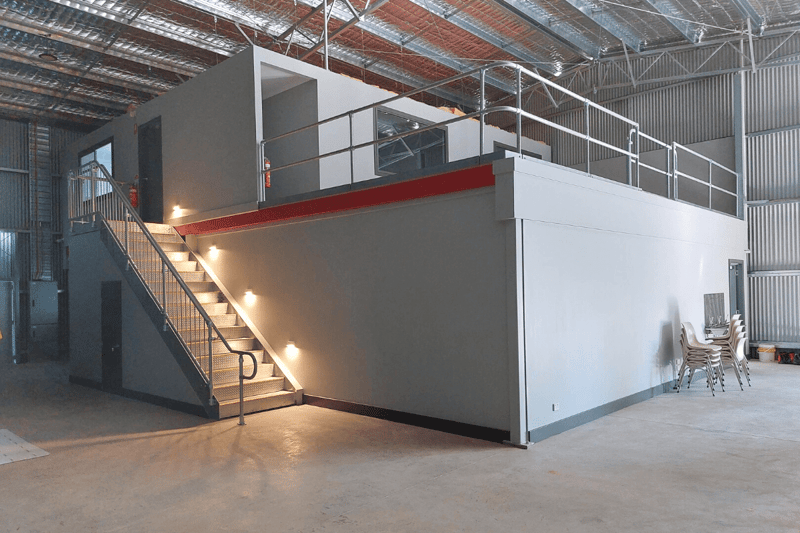
Office fit-outs and amenities typically add $800 to $2,500+ per m² of office or amenity area, depending on finishes, services, and how much of the area is being conditioned.
Mezzanines
Storage only mezzanines can often add around $75 to $150 per m² of mezzanine area. More usable mezzanines commonly sit around $200 to $400+ per m², due to extra structural, access, and fit out requirements.
Gantry cranes
Light duty systems can start around $10,000 to $30,000+, while heavier or specialised setups can range $50,000 to $300,000+, depending on lifting capacity, span, runway requirements, and integration engineering.
Roller doors and large openings
Standard manual roller doors are typically a few thousand dollars per door. Larger openings or motorised doors often sit in the $5,000 to $20,000+ per door range depending on size, wind rating, insulation needs, and automation.
Firewalls and sprinklers
Firewalls can add several thousand to tens of thousands depending on the rating and detailing. Sprinkler systems are often budgeted as a per square metre allowance, commonly $20 to $70+ per m², depending on hazard classification and water supply requirements.
Electrical and lighting
Electrical scope varies widely. A typical allowance for electrical and lighting can be around $100 to $250 per m², depending on high bay lighting, controls, three phase requirements, and task specific needs.
Security and access control
Smaller facilities may budget around $3,000 to $15,000+, while larger or integrated systems commonly fall in the $15,000 to $50,000+ range, depending on coverage, monitoring, and integration requirements.
What to ask for so quotes are comparable
Quotes often differ because assumptions differ. To compare like for like, request that each quote clearly lists:
- shed footprint, span, wall height, and roof pitch assumptions
- wind exposure assumptions and structural inclusions
- cladding type, roof type, insulation allowance if any
- number and size of doors and openings
- included accessories and finishes
- what is included and excluded, especially slab, services, approvals, and site works
- lead times, installation scope, and site access requirements
If a quote looks cheaper, it is often because something is excluded or assumed away. The best value quote is the one with the clearest scope, not the shortest number.
A simple budgeting worksheet you can use
If you want a practical way to budget, create a simple spreadsheet with these line items:
- Base shed structure
- Slab and foundations allowance
- Site works and drainage allowance
- Approvals and certification allowance
- Electrical and lighting allowance
- Plumbing and amenities allowance
- Fit out allowance, offices, walls, linings
- Mechanical and ventilation allowance
- Fire and safety allowance
- External works allowance
- Contingency allowance
Even if some lines are zero, having them listed prevents blind spots and makes it easier to refine your budget as you confirm scope.
How much contingency should you allow
At early planning stages, allow a contingency because unknowns are normal. Site conditions, services, compliance requirements, and fit out decisions often evolve during planning.
A sensible approach is:
- smaller simple builds, lower uncertainty, allow a smaller contingency
- larger builds, site unknowns, more services and fit out, allow a higher contingency
If your site is known to be challenging, coastal, sloped, restricted, or remote, increase your contingency rather than hoping it comes in clean.
Getting an accurate quote
If you want an accurate budget, the best next step is a quote based on your site, shed size, and what you need included. If you are planning a steel shed for industrial or commercial use, view our steel shed and industrial building solutions and request a tailored quote.
To help plan your project, you can also download our brochure below.
.svg)